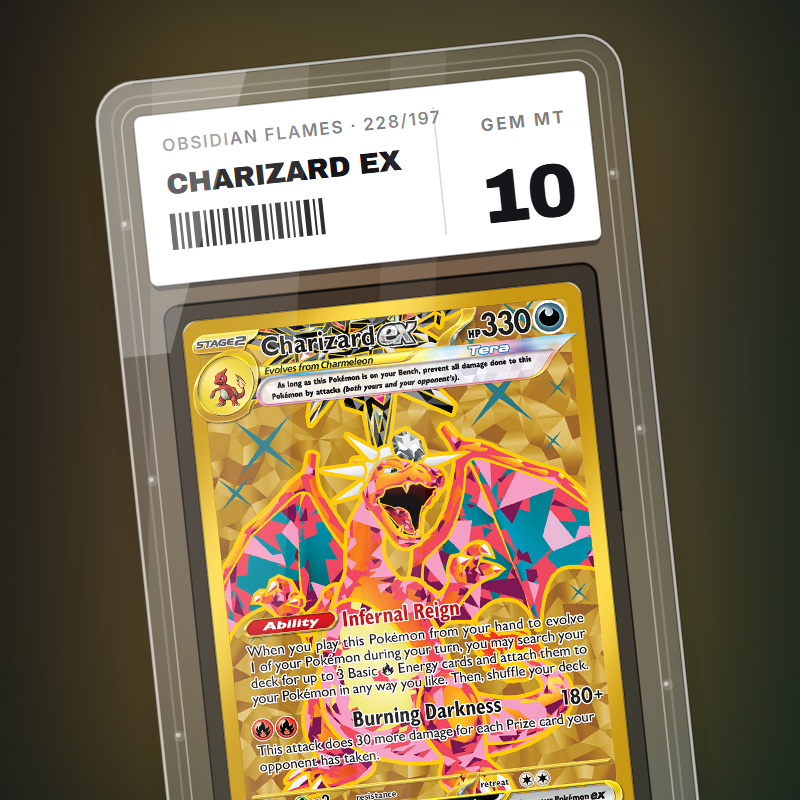
Comparison · September 16, 2026
Everyone Wants to Grade the Gold Charizard. The Math Says Don't.
Half of every gold Charizard ex #228 sent to PSA comes back a 9 that loses money. Full population breakdown, the real odds, and the grading math at PSA's new $59.99 Standard tier.
Published Sep 16, 2026 · Data as of Sep 16 (sales) and Jul 13 (population) · Fees per PSA’s Sep 14 restructure
Verdict up front: keep it raw. Half of everything collectors submit comes back a PSA 9, and a PSA 9 on this card loses money. The full numbers are below, in plain math.
The gold Charizard ex, card #228/197 from Obsidian Flames, might be the most tempting grading target in its set. It is shiny, it is Charizard, and a graded gem sells for about $262.99 against a $30 raw card. That gap is exactly why so many copies get sent in. It is also why the math deserves a hard look before yours does.
Nearly 40,000 of these already live in slabs
Start with the population: the running count of how many copies each grading company has ever graded. Our snapshot from July 13, 2026 puts the PSA total at 34,019 copies. Add CGC, Beckett, and SGC, and nearly 40,000 slabs of this one card exist. Scarcity is not this card’s story, and it never will be.
| Grader | Graded copies | Grade 10s |
|---|---|---|
| PSA | 34,019 | 9,031 |
| CGC | 3,856 | 986 |
| Beckett | 969 | — |
| SGC | 874 | 304 |
What actually comes back when you submit
Population data answers a second question, and it is the important one. Out of every hundred copies PSA has graded, how many earned each grade? Here are those odds, next to what each outcome sells for.
| Outcome | Odds | Sells for |
|---|---|---|
| PSA 10 | 26.5% | $262.99 |
| PSA 9 | 49.9% | $45.00 |
| PSA 8 | 18.5% | ~$40 |
| PSA 7 or lower | 5.1% | ~$32 |
PSA 10 and PSA 9 prices are 90-day medians from our own sales tracking. Grade 8 and below are thinner markets, valued per PriceCharting.
Read the middle row again. Half of every gold Charizard sent to PSA comes back a 9. Getting there costs about $90 — a $30 raw card plus the $59.99 grading fee. The card that returns sells for $45.00.
That is the trap in one sentence. The single most likely outcome hands you back half of what you spent.
The fee math, at both of PSA’s new tiers
PSA reshaped its US service levels on September 14, 2026. A new Standard tier opened at $59.99 a card, with a 90 to 100 business-day wait. The faster Priority tier, formerly called Regular, runs $79.99.
Now the expected-value math. Take every outcome above, multiply it by its odds, and add it all up. The average graded copy comes back worth about $101. Subtract the fee and you hold about $41 on Standard, or about $21 on Priority — against $30 for selling the same card raw.
So the best case is a margin of about +$11 per card, before shipping and insurance. Those costs run past $11 on almost any submission. Priority is simply underwater, at about −$9 before shipping. And your money sits in PSA’s queue for four to five months while the market keeps moving.
But the PSA 10 is $262.99…
The counterargument sits right there in the table: a gem at 8.8 times raw. That number is real, and it is why submissions keep coming. But the expected-value math above already counts it, at its true one-in-four odds. A lottery ticket is still a lottery ticket when it costs $59.99 and takes five months to scratch.
One more honesty note, and it cuts against you. Population odds describe cards people chose to submit, and many of those were screened by sharp eyes first. A random copy pulled from a binder likely gems below that 26.5%.
What about CGC? Its 10 is rarer here: 986 exist against 9,031 PSA 10s. But that market is thin, and our tracking sees only scattered sales. For this card, the liquid exit is a PSA slab, same as the rest of the set.
What would flip this verdict
This verdict is about the fee, not the card. At PSA’s old $24.99 Value price, the same math cleared with about +$46 of room. PSA has tied Value’s return to its backlog falling to 5 million cards, and our guide to the pause tracks that story.
A sharp move in the PSA 10 price would change the inputs too. For now it is moving the wrong way. The card slid on PriceCharting this week, and set mate #223 posted double-digit drops in our Weekly Movers.
Keep it raw — at today’s fees and prices. The gem odds are one in four, the most likely outcome loses money, and the best-case margin disappears into shipping. Run your own copy through the break-even calculator on the card page. Not investment advice — this is what the market and the math say today.
Method: odds derived from the SlabVerdict population snapshot (Jul 13, 2026, PSA total 34,019). PSA 10 and PSA 9 values are 90-day medians of SlabVerdict-tracked sold sales (190 sales tracked since mid-July; as of Sep 16, 2026). Levels cross-checked against PriceCharting on Sep 16, 2026.
Fees per PSA’s September 14 restructure, verified on PSA’s official pages Sep 16, 2026. The full framework behind this calculation is in Is your Pokémon card worth grading?